Stakeholder Management & Team Collaboration
BA Academy — self-paced module
By the end of this module, you will be able to:
- Prepare for a project launch and produce the standard launch deliverables
- Identify stakeholders systematically (including with SIPOC), categorize them on an influence/interest matrix, and manage them through a project
- Build and read a RASIC responsibility matrix
- Guard project scope: recognize scope creep and run a change request process
- Run meetings people appreciate, build trust deliberately, flex among influencing styles, and practice empathy-based collaboration
- Explain the V2MOM alignment framework and write one
The People Side of the Craft
Modules 3 through 15 taught you what to do. This module is about the people you do it with: identifying them, understanding them, earning their trust, aligning them, and keeping a project's boundaries intact while human beings push on them from every side. If 80 percent of a BA's time involves communication (Module 1), this module is about making that 80 percent count.
Project Launch: The BA's Opening Moves
Every project has a launch window, and BAs who use it well start ahead. Before kickoff, on your own initiative:
- Review and understand the background documentation: the Statement of Work (SOW) and the RFP response, if there was one (these define what was promised, which is what scope means)
- Ask your PM for everything the client provided: business process or end-user documentation, process and system diagrams, a stakeholder register or org chart
During launch, the BA contributes a standard set of deliverables, every one of which you now know how to build: the stakeholder matrix (RASIC, below), a requirements gathering plan (Module 3), initial requirements and user stories (Module 4), high-level current and future state process maps (Module 5), the RAID log (Module 10), the document repository setup, a communication plan, and a change management plan (Module 15). Launch is where the whole toolkit gets laid out on the bench.
Stakeholders: Finding and Understanding Them
Stakeholders are individuals, groups, or organizations with a vested interest in the outcome of a project. They can influence its success, and they provide essential input, feedback, and requirements. More broadly: anyone who may affect, be affected by, or perceive themselves to be affected by the work: internal and external, including regulators whose compliance requirements shape what you build. Identifying and engaging them is a critical part of the BA role, because their perspectives shape the solution and determine whether the final product meets the needs of everyone involved.
Finding Stakeholders with SIPOC
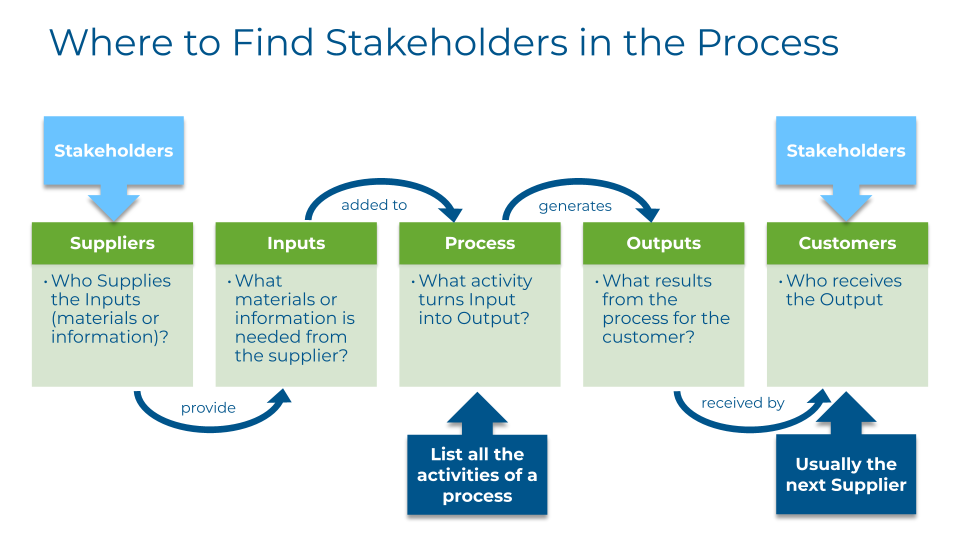
How do you find stakeholders you do not know about? Walk the process. SIPOC (Suppliers, Inputs, Process, Outputs, Customers), which you met as a scoping diagram in Module 5, doubles as a stakeholder detector:
- Suppliers: who provides the inputs (materials or information)?
- Inputs: what does the process need from them?
- Process: what activities turn inputs into outputs?
- Outputs: what does the process produce?
- Customers: who receives the outputs (and is usually the next process's supplier)?
Every supplier and every customer of every process step is a stakeholder. Facilitation tip: if the team struggles, start with the Process column (populate it from your current or future state map), then work outward to inputs/outputs and suppliers/customers. A robust SIPOC exposes the links between steps and hands you a stakeholder list you did not have to guess at.
The Influence/Interest Matrix
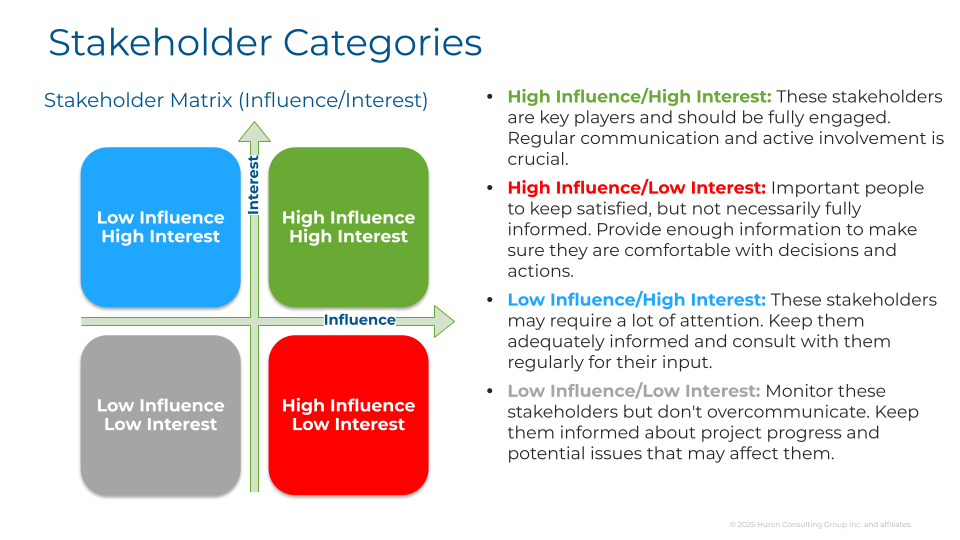
Not all stakeholders need the same attention. The stakeholder matrix (influence/interest grid) classifies them along two axes: their influence (power) over the project, and their interest in it: producing four quadrants with four engagement strategies:
- High influence / high interest: the key players. Fully engage them: regular communication and active involvement are crucial.
- High influence / low interest: keep them satisfied. Provide enough information that they stay comfortable with decisions, without burying them in detail they did not ask for.
- Low influence / high interest: keep them adequately informed and consult them regularly: they may need a lot of attention, and they are often your best sources of ground truth and your future champions.
- Low influence / low interest: monitor. Keep them informed of progress and issues that may affect them, but do not overcommunicate.
The matrix is a living document: reorganizations, promotions, and project events move people between quadrants mid-project. Revisit it at every phase gate. (A candid note from the source material: as a newer analyst you are not expected to personally manage C-level stakeholders: but you are expected to understand the map, because your communication plan is built on it.)
The Stakeholder Management Process
Seven steps, spanning the whole project:
- Identify all stakeholders, internal and external, with interest or influence
- Prioritize them, using tools like the influence/interest grid and the RASIC matrix
- Understand expectations early: gather their requirements, needs, and concerns through meetings or surveys
- Engage them in decision-making: involve key stakeholders in important decisions and milestones (decisions people helped make are decisions people defend)
- Manage conflicts: identify and address them early; use negotiation to balance competing interests
- Set realistic expectations: be clear about scope, timelines, and limitations to prevent misunderstandings
- Seek feedback after completion to understand satisfaction and feed lessons learned (Module 17)
The Two Forgotten Stakeholder Groups
A hard-won field lesson from the source material: when programs discuss stakeholders, they usually mean executive sponsors and senior business and IT leaders. Engaging those is paramount, but two other groups matter just as much, and are routinely forgotten:
- Middle management: the critical layer, focused on keeping the lights on and delivering annual commitments within allocated budgets. New, unplanned project demands land on them hardest. Win them early (Module 15 said the same from the change side) or watch the project stall in the middle of the org chart.
- End users: the people who will live in the solution daily. If they see no value, they simply will not use it.
The cautionary tale, anonymized from a real consulting engagement: a company set out to automate a complex paper-based defect-tracking process. The old process's requirements were never clearly communicated to the developers; the budget was owned entirely by IT, so the business never resourced UAT (their priorities were elsewhere); and end users, comfortable with the old way, saw no value in the new system and did not use it. Cost overruns, a rescue effort, and an avoidable mess: all traceable to alignment that was never created at the start. The moral: the business "throwing requirements over the wall" to IT is the classic failure pattern, and a real partnership across business and IT stakeholders, documented in a shared program vision, is the path to value. Formal governance frameworks exist for exactly this (the source cites an enterprise-IT governance standard whose first principle is that shared vision document), but the practice matters more than the framework name.
Stakeholder Matrix
SIPOC
RASIC: Who Does What
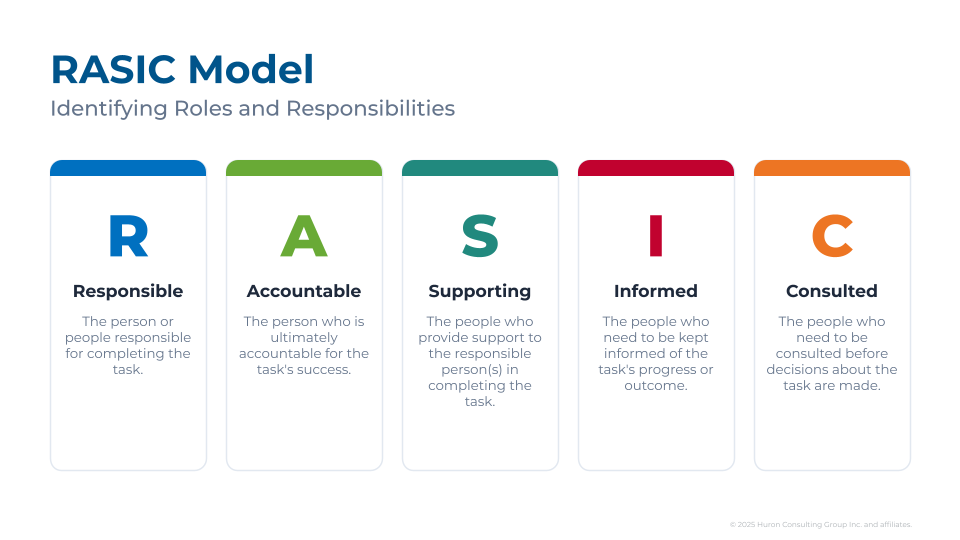
With stakeholders identified, define their roles per task. RASIC is a responsibility assignment matrix that defines roles and responsibilities for a project, communicating who is responsible for each task. Its benefits: clear communication, better decision-making, ensured accountability, less confusion about who owns what, and prevention of miscommunication and task overlap.
The five roles:
- R: Responsible. The person or people who complete the task.
- A: Accountable. The person ultimately answerable for the task's success.
- S: Supporting. People who help the responsible person complete the task.
- I: Informed. People kept informed of progress or outcomes (passive, one-way).
- C: Consulted. People whose input is sought before decisions (active, two-way).
(You may also see this called a RACI chart: RASIC adds the Supporting role to capture people who help without owning the task. Same concept, fuller version: this course standardizes on RASIC.)
The cardinal rule: only one role should be Responsible or Accountable for a given task. When two or more roles could share it, define which is primary; everyone else supports, consults, or gets informed. A task with two owners has zero owners, and a RASIC row with three R's is a future argument, scheduled.
In practice: build the RASIC in a workshop, not at your desk: the negotiation over each cell is the alignment. And keep it visible: a RASIC nobody can find governs nothing. (For a live example of RASIC thinking applied to the BA career itself, see Module 18, which is built on exactly such a matrix.)
RASIC Matrix
Guarding Scope
Whose Job Is Scope?
Precision matters here: keeping the project within scope is the PM's responsibility. Monitoring for potential scope creep is the entire team's job, with concerns brought to the PM. The BA's specific duties:
- Read and understand the contract documents, so you know what is and is not in scope (this is why launch prep starts with the SOW)
- Lead discovery sessions so they stay on track and cover all in-scope material
- Work with the team to keep requirements and solutions within scope
- Bring scope-creep concerns to the PM's attention and assist with the mitigation strategy
- Capture the details of requested scope changes
- Maintain communication with the client to manage expectations and avoid surprises
Scope Creep
Scope creep is the gradual, often uncontrolled growth of a project's scope after the project has begun: additional features, functionality, or requirements added without proper approval, increasing complexity, timeline, cost, and risk. It typically happens when there is no formal change management process, or when nobody revisits the original objectives. It rarely arrives as a demand; it arrives as a reasonable-sounding "while you're in there, could you also...". Each request is small. Their sum is a different, larger, unfunded project.
Scope creep sits atop the standard list of BA challenges and operational risks, alongside its cousins: frequent changes in scope, reluctant stakeholders, misalignment between business needs and technology, conflict among stakeholders, lack of clarity on requirements, and the eternal struggle of getting stakeholders to make time for the project. Every one of those risks is managed with the tools in this module: the matrix tells you whom to engage, RASIC tells you who owns what, and the change request process (next) converts creep into controlled change.
The Change Request Process
A change request (CR) is a formal proposal to modify the scope, objectives, or deliverables of a project. The BA's role in the CR process is crucial: you ensure proposed changes align with business objectives, are well documented, and are evaluated for impact before being approved and implemented. The flow: capture the request in writing, assess its impact (effort, cost, schedule, risk: with the team), route it to the right decision-makers (your governance body from Module 15), and record the decision either way (your RAID log's D column).
Managed this way, change requests are healthy: projects should adapt as understanding grows (that is Module 10's whole philosophy). The difference between agility and creep is exactly one thing: the decision was made deliberately, by the right people, with the impact known. Remember the UAT lesson from Module 12: in-scope issues get fixed; out-of-scope wishes become CRs or backlog items. Same line, drawn earlier.
Meetings People Appreciate
You will run thousands of meetings in this career. People do not want more meetings; they appreciate productive ones, so make yours meaningful:
- Always send an agenda beforehand. It tells people what you hope to accomplish with their valuable time, sets expectations, lets them prepare contributions, and gives you a legitimate tool for pulling a wandering meeting back on track. If you need something specific from someone, tell them personally in advance.
- Prepare a presentation for every meeting, no matter how small. It makes you look prepared (because you are), gives the meeting structure, acts as a signpost for latecomers, carries helpful context like definitions, and gives eyes something to focus on.
- Record meetings when permissible, with consent. Recording frees you to be fully present instead of stenographing; parse details afterward, and when memory disputes arise, the recording remembers everything.
- Recap before closing. Summarize what was covered, what was decided, and who owes what: then confirm it in writing.
Two timing principles complete the meeting craft:
- Understand, then solution. Resist solutioning before requirements are known: it anchors everyone on a half-informed answer (the same discipline as Module 3's solution-agnostic elicitation, applied to meetings).
- Deliver a quick win early. An early, visible, useful deliverable, even a small one, buys trust you will spend later when the project hits its hard patch. (Kotter's short-term wins, Module 15, at project scale.)
Trust: The Currency of Collaboration
Trust is not a soft nicety; it is measurable business value. Research on workplace trust finds it drives employee engagement, learning and productivity, teamwork and collaboration, risk-taking and innovation, customer loyalty and retention, and business results and profit growth. And its absence is expensive: without trust, people put in less effort, disengage, or leave: or worse, "quit and stay," dragging morale and productivity down from the inside.
Organizations measure trust (customer surveys, employee surveys probing communication transparency, whether leaders admit mistakes, openness to ideas, confidence in leadership: entire best-workplace rankings are built on trust indexes). You should measure yours personally, with an honest self-audit: Do people bring you problems early or late? Do they ask for your help? Do they tell you when you are wrong?
Building and maintaining trust comes down to five practices:
- Make personal connections. Know your colleagues and clients as people, not role labels.
- Be transparent. Share reasoning, share status honestly (bad news early beats bad news late, every time), share credit.
- Act on feedback. Soliciting input and ignoring it destroys more trust than never asking.
- Own your mistakes. Admitting error quickly is a trust accelerant; hiding it is a trust bankruptcy.
- Be consistent. Do what you said, every time, small things included. Reliability compounds.
For a BA, trust is literally the working capital: stakeholders tell trusted analysts the real requirements, the awkward workarounds, and the political landmines. Untrusted analysts get the sanitized version, and sanitized requirements build the wrong system.
Influence: The Right Style at the Right Time
A story from the source material that every BA should keep handy: Patrick's finance team built a genuinely better expense system: a huge improvement everyone should have loved. He announced it in a company-wide post. The finance team clicked "like"; everyone else posted grievances and refused to use it. What went wrong? Patrick and his department never involved any employees in the design, never got alignment or buy-in, and never communicated the project in advance. They fell in love with their solution and forgot their internal customers, and how important influencing and involving others is when initiating change.
As organizations flatten and work goes global, you will constantly need to influence people you have no direct authority over: which is the BA's permanent condition. The key insight: people have different natural influencing styles, and effectiveness means using the right style at the right time for your audience rather than defaulting to your favorite. The five styles:
- Collaborative: present ideas and invite input; build the answer together
- Assertive: state positions directly and drive to an outcome
- Analytical: persuade with data and logic
- Accommodating: make trade-offs and compromises to reach agreement
- Inspiring: paint the vision and appeal to shared purpose
None is best; each fits circumstances. Data-skeptical executives need inspiring framing; a detail-oriented architect wants the analytical case; a stalled negotiation may need accommodation; a safety issue needs assertion. Identify your own go-to style honestly (most people over-rely on one), then practice the others. Before any high-stakes interaction, build a small influence plan: who am I influencing, what do they care about, which style fits, and what does success look like?
Empathy and Skilled Relationships
Underneath trust and influence sits emotional intelligence (EI): self-awareness (knowing what you feel), self-management (choosing your response), empathy, and relationship skill: each building on the last.
Empathy is the ability to recognize and understand others' emotions and take active interest in their concerns. We are built for it: mirror neurons fire both when we act and when we watch someone else act, which is why you wince at another's stubbed toe. But modern work strains empathy: screens, character limits, and distance make it harder to feel what colleagues feel: so remote professionals (that is you) must practice it deliberately.
Distinguish empathy from sympathy: sympathy observes from the outside ("that sounds hard"); empathy joins someone in their experience and communicates that they are not alone. In stakeholder work this is the difference between noting an objection and understanding why the change threatens someone: and only the second one lets you actually help (recall the Bridges model from Module 15).
Skilled relationships are what EI produces: relationships characterized by mutual trust, inspiration, and joint problem-solving. Two practical tools:
- Team agreements: a "job description for the entire team," describing successful behavior and guarding against morale-harming actions. Build one by answering, together: How do we work together (tools, roles, time zones)? What does success look like (metrics, what we do about mistakes)? How do we agree and disagree (which forums, what milestones for reflection)? How do we decide who plays which role? (Module 17 scales this idea up into the formal project teaming agreement.)
- Work-style awareness: teammates differ in how they approach tasks, coordination, and organization. Noticing and accommodating styles, rather than resenting them, is relationship skill in daily practice.
V2MOM: Alignment on One Page
The final tool in this module solves collaboration's biggest silent killer: misalignment. Getting everyone in an organization moving in the same direction is hard: one famous Harvard study found as little as 7 percent of employees fully understand their company's strategy and what is expected of them to achieve it. Yet employees crave alignment: clarity on how their work contributes, a sense that it makes a difference, and belonging to something bigger than themselves.
Picture the whole company in a boat, everyone holding an oar. Rowing hard is not enough: competitive crews win because every catch and release is perfectly synchronized. Alignment is that synchronization, and V2MOM is the framework Salesforce itself has used since its founding to create it. The acronym:
- Vision: what you want to achieve or accomplish: a bold, inspiring picture of the future. (President Kennedy's 1961 moon-landing commitment is the classic example of a vision: audacious, vivid, time-bound. A famous online retailer's founding vision, "a place where people can find and discover anything they might want to buy online," shows a corporate one that came true.)
- Values: the principles and beliefs most important to you as you pursue the vision: they guide everyday decisions.
- Methods: the actions and steps you will take to get it done: the how.
- Obstacles: the challenges and issues you anticipate having to overcome: named in advance, honestly.
- Measures: the measurable results that define success: how you know you achieved it.
Measures should be SMART: Specific, Measurable, Achievable, Relevant, and Time-bound. "Improve volunteer engagement" is a wish; "increase repeat-volunteer rate from 40 to 55 percent by December 31" is a measure.
What makes V2MOM more than a poster: it cascades.…
What makes V2MOM more than a poster: it cascades. The company writes one; every function, team, manager, and employee writes their own, aligned upward: so anyone can trace how their measures serve the mission. And it is written collaboratively: draft it in a shared document, let the team comment, then spend a working session (two to four hours) reviewing and challenging it together, so everyone is bought in before individuals draft their own. Do not let people copy-paste the team's V2MOM and call it a day: engagement comes from customizing their own vision, methods, and obstacles (personal development and wellness goals included).
living document
Finally, the V2MOM is a living document: use it in one-on-ones to prioritize work, let it guide decisions about time and budget, have everyone update it quarterly and discuss progress, and formally refresh it mid-year against current priorities. The check-in questions: What progress have you made? Do your current projects fit your methods? Are your measures still accurate? What is your plan for next quarter?
For a BA, V2MOM has double value: use it…
For a BA, V2MOM has double value: use it yourself (write one for your own career transition: seriously, this course is a fine occasion), and recognize it in clients. When an organization has a V2MOM or anything like it, discovery just got easier: their vision, obstacles, and measures are your requirements context, pre-written.
Key Takeaways
- Start projects by reading the SOW and client documentation, then deliver the launch kit: stakeholder matrix, requirements plan, initial stories, process maps, RAID log, repository, communication and change plans.
- Find stakeholders systematically (SIPOC's suppliers and customers), categorize them by influence and interest, engage each quadrant appropriately, and never forget middle management and end users: the two groups whose neglect sinks projects.
- RASIC assigns Responsible, Accountable, Supporting, Informed, and Consulted per task: one R, one A, negotiated in the open, kept visible.
- Scope is the PM's to keep and everyone's to watch: the BA knows the contract, keeps discovery on track, captures change details, and feeds the formal change request process. Agility is deliberate change; creep is unapproved change.
- Meetings earn appreciation through agendas, structure, recordings (with consent), and closing recaps: understand before solutioning, and bank an early quick win.
- Trust drives measurable business results and is built through personal connection, transparency, acting on feedback, owning mistakes, and consistency. Influence works when you flex among collaborative, assertive, analytical, accommodating, and inspiring styles to fit the audience.
- Empathy (joining, not just observing) plus team agreements and work-style awareness produce skilled relationships: the daily fabric of collaboration.
- V2MOM aligns organizations one page at a time: Vision, Values, Methods, Obstacles, and SMART Measures, cascaded, collaboratively written, and refreshed as a living document.
Knowledge Check
8 questions. Answer at your own pace, then check the explanation for each.
Module 16 complete
Nice work. Review any question again using the menu (top right), or move on.
Continue to Module 17: Teaming Agreements & Lessons Learned →