User Stories, Acceptance Criteria & Requirements Docs
BA Academy — self-paced module
By the end of this module, you will be able to:
- Trace how project documentation flows from the Statement of Work through discovery notes to user stories and the solution design
- Write well-formed user stories using the "As a..., I want..., so that..." format
- Apply the INVEST checklist to judge and improve user stories
- Write clear, testable, solution-agnostic acceptance criteria in multiple formats
- Build and maintain a Requirements Traceability Matrix (RTM)
- Describe the major requirements documents (BRD, FRD, SoW, User Manual) and when each is used
From Conversation to Buildable Work
Module 3 taught you to elicit needs. This module teaches you to write them down so a team can build from them. That translation, from a stakeholder's spoken frustration to a precise, testable work item, is arguably the single most marketable skill a BA has.
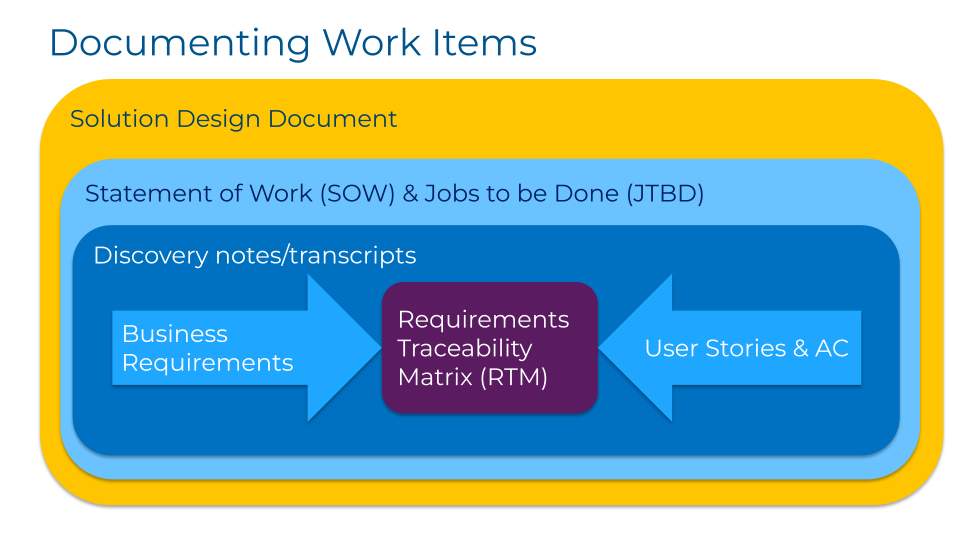
Documentation on a typical project flows like this:
- The Statement of Work (SOW) and early Jobs to Be Done framing give a high-level picture of what the project is and why.
- Discovery notes and transcripts capture everything elicited in workshops and interviews: the raw material.
- From that raw material you distill business requirements: the high-level objectives the project must achieve.
- Business requirements feed the Requirements Traceability Matrix (RTM), which connects each requirement to the user stories, features, and test cases that fulfill it.
- Requirements are decomposed into user stories with acceptance criteria: the units of buildable, testable work.
- The Solution Design Document (owned by the Solution Architect, with BA contribution) addresses the deeper-level requirements and describes how the solution will actually be built.
Keep this pipeline in your head. Every artifact in this module has a place in it, and when a stakeholder asks "where did this user story come from?", the pipeline is your answer: it traces back through the RTM to a business requirement to a discovery conversation.
Work Items
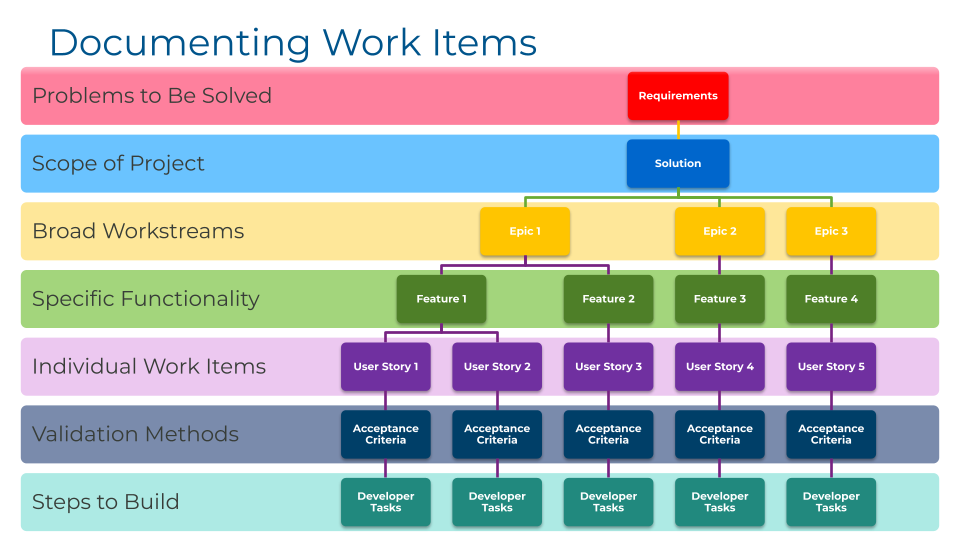
User Stories
A user story is a short description of a piece of functionality, written from the perspective of the person who needs it. The canonical format:
As a [specific type of user], I want [what], so that [why].
Each of the three parts earns its place:
- Who: which specific users need this functionality. Not "the user" in the abstract: a sales rep, a volunteer coordinator, a case manager. The who determines permissions, training, and design choices.
- What: the specific task the functionality should allow the user to complete.
- Why: why this task matters to the user, and what the overall value to the business is. The why is the part teams are most tempted to skip and the part that most often prevents building the wrong thing. If you cannot articulate the why, you have not finished discovery on that story.
A user story is deliberately not a technical specification. It describes the need from a user-centric perspective and leaves the how to design conversations. This is the same solution-agnostic discipline you learned with Jobs to Be Done in Module 3, applied at the feature level. (Recall the distinction: a job story frames the broader challenge; user stories specify the solution features. One job story often spawns many user stories.)
INVEST in Good User Stories
Well-written user stories and high-quality acceptance criteria lay the foundation for a successful build. The industry-standard quality checklist is the acronym INVEST. A good user story is:
- Independent: each story (and each acceptance criterion) is clearly identifiable and separate from the others. Independent stories can be prioritized, built, and tested without dragging a tangle of other work along.
- Negotiable: stories are open to discussion and client approval before finalization. A story is an invitation to a conversation, not a contract carved in stone.
- Valuable: each story serves an identifiable purpose toward the overall project. If nobody can say who benefits, the story should not exist.
- Estimable: the team can determine a story's level of effort. If a story cannot be estimated, it is usually too vague or too big, and either way it cannot be scheduled responsibly.
- Small: sized appropriately to the project's context: typically something a team can complete within a sprint. Big stories hide surprises; small stories surface them early.
- Testable: a QA or UAT tester can clearly identify what needs to be tested. If you cannot imagine the test, you cannot claim the story is done.
Use INVEST as a review pass on every story you draft. Most weak stories fail on Small (it is really three stories), Testable (no measurable outcome), or Valuable (the why is missing).
Acceptance Criteria
A user story tells you what the user needs. Acceptance criteria (AC) define, in measurable terms, what a successful implementation looks like: the definition of done for that story. A story without acceptance criteria is a wish; a story with them is a work item.
Three principles govern good AC:
1. Measurable and specific. Acceptance criteria provide a more technical and testable definition of success than the story itself, ensuring the completed product aligns with the client's requirements. Every criterion should be something a tester can check and mark pass or fail.
2. Solution agnostic. Write AC in terms of what the user can do and what the system does in response, not in terms of Salesforce internals. Do not specify "create a custom field" or "update the flow": describe the observable outcome instead. Two reasons. First, the focus stays on the user's needs and desired outcomes rather than prescribing a technical approach, which keeps the product adaptable to better designs and future enhancements. Second, stakeholders must approve these criteria, and you want sign-off conversations in plain business language, not Salesforce jargon that confuses the people whose approval you need.
3. Written with the story, not after the build. AC drafted after development merely describe what got built. AC drafted before development direct what gets built. The difference is the whole point.
Acceptance Criteria Formats
Several formats are in common use. Choose per criterion; a single story can mix them.
Given / When / Then (scenario format):
Given [precondition or context], When [specific action or event], Then [expected outcome].
Example: Given the user is logging into their account, when the user clicks "Forgot Password," then they receive an email with a password reset link.
Rule-based format:
If [condition], Then [outcome], Else [alternative outcome].
Example: If the user enters valid payment information, then the payment is processed successfully; else the user is shown an error message.
Checklist format: a plain list of verifiable statements. Example: Users can sign up using their email. An email verification link is sent upon sign-up. An invalid email shows an error message. Passwords must meet complexity criteria.
Edge case / negative scenario format: explicitly capture what happens when things go wrong. Example: Given an invalid email address, when the user tries to submit the registration form, then an error message is displayed.
That last format deserves emphasis. Inexperienced BAs write only the happy path. Experienced BAs ask: what if the input is invalid, the record already exists, the user lacks permission, or the network drops? Negative scenarios are where production incidents are born, and where good AC prevent them.
Worked Case Study: WellCare Solutions
Time to put the pieces together, end to end. This scenario mirrors real consulting work closely.
Scenario: You are the BA for a subscription-based HealthTech company, WellCare Solutions (a fictional company), which needs a Salesforce CRM implementation to improve sales tracking and renewals.
Step 1: The Raw Material
Here is an excerpt from a discovery workshop with the client:
"Our sales reps struggle to keep track of leads and renewal opportunities. Right now, everything is in spreadsheets, and we have no way of knowing when a contract is about to expire. Some deals get lost because we forget to follow up. We also don't have a clear way to see which deals are in progress and what stage they're in. Our leadership wants real-time insights into the pipeline so they can forecast revenue better."
Step 2: Identify Pain Points
Read the excerpt like an analyst. Five distinct pain points hide in those five sentences:
- No centralized system (everything lives in spreadsheets)
- Missed follow-ups (deals get lost)
- Lack of visibility into deal stages
- No automated alerts for contract renewals
- Lack of real-time reporting for leadership
Notice the discipline: each pain point is separate, even though the client delivered them in one breath. Separating them is what makes the next step possible.
Step 3: Draft User Stories
Each pain point becomes at least one user story:
| Title | Persona | Requirement | Value |
|---|---|---|---|
| Lead Management | As a Sales Rep | I need the ability to easily add new leads in the CRM | so that I can communicate with those opportunities effectively in one place |
| Lead Tracking | As a Sales Rep | I need the ability to track leads and see which stage of the process they are in | so that I can manage my pipeline and avoid missing sales opportunities |
| Contract Renewal Alert | As a Sales Rep | I need the ability to know when a contract is about to expire | so that I can take action to work toward a renewal |
| Automated Follow-ups | As a Sales Rep | I need tasks generated automatically for a lead or renewal opportunity | so that I never miss a critical follow-up |
| Reports & Analytics | As a Manager | I need a real-time report showing an overview of leads and renewal opportunities | so that I can track all important updates in one place and forecast revenue more accurately |
Run the INVEST check: each story is independent (separate functionality), negotiable (nothing prescribes a technical design), valuable (each traces to a stated pain), estimable and small (a team can size each one), and testable (each implies observable outcomes). Also notice the personas differ: four stories serve the sales rep, one serves the manager. Getting the who right shapes permissions and design downstream.
Step 4: Ask the Follow-up Questions
Here is a hard-won lesson: stakeholders fail to disclose critical details unless you ask the right questions. Drafting the stories exposes the gaps. Before these stories are buildable, a good BA asks:
- What defines a qualified lead for your team?
- When, and how frequently, should automated follow-ups be triggered?
- What should renewal alerts be based on: contract start date, end date, or both?
- What KPIs (key performance indicators) do you want on the reports and dashboards?
- How are you tracking this data today, and are any existing integrations in place?
Make this a permanent habit: drafting user stories is itself an elicitation technique. The act of writing them reveals what you do not yet know.
Step 5: Write Acceptance Criteria
With answers in hand, write the definition of done for each story. Worked examples:
Lead Management (As a Sales Rep, I need the ability to easily add new leads...): - Sales rep can add a new lead in the system - Users can see the sales rep assigned to a lead - Sales rep can enter lead details including name, contact information, and address - Sales rep can send an email to the lead from within the CRM
Lead Tracking: - Sales rep can assign the lead's stage using a field on the lead's detail page - Sales rep can change the stage to any other stage and save the change - Only the sales rep who owns the lead, and people above them in the hierarchy, can change the stage
Contract Renewal Alert: - Sales rep can view the contracts they own in the system - Sales rep can see each contract's start and end dates - Sales rep is notified 90, 60, and 30 days before a contract expires, via email to their user's email address - Sales rep can associate a task to a contract with details on the action to take
Automated Follow-ups: - Tasks are automatically generated when a renewal opportunity reaches a defined stage - Tasks are assigned to the opportunity's owner - Tasks capture the action to take, due date, and task owner - Users can see all tasks associated with an opportunity on its detail page - Users can also create tasks manually and relate multiple tasks to one opportunity
Reports & Analytics: - Manager can see: total leads in the system, total opportunities, leads by stage, and opportunities expiring within 90, 60, and 30 days - Managers can edit or clone the dashboard - Only managers and people above them in the hierarchy can view these reports and dashboards
Study what these criteria do and do not say. They specify observable behavior ("notified 90, 60, and 30 days before expiration") and never the mechanism (no field names, no flow design, no object model). They include permissions ("only the sales rep who owns the lead..."), which new BAs chronically forget. And every line is testable: a UAT tester could sit down with this list and verify each item.
The Requirements Traceability Matrix (RTM)
With dozens of requirements and hundreds of stories on a real project, how do you guarantee nothing slips through the cracks? The Requirements Traceability Matrix is the BA's answer: a document that catalogs every requirement and tracks it through the project lifecycle, ensuring each one is addressed by the project's deliverables and validated by testing.
An RTM is typically a spreadsheet with columns for: Requirement ID, Requirement Description, Source, Associated Feature, User Stories, Test Cases, and Status.
A worked example:
| ID | Requirement | Feature | User Story | Test Cases | Status |
|---|---|---|---|---|---|
| REQ-001 | User must be able to manage their account | Login | As a user, I want to log in to access my dashboard | TC001: Login with valid credentials | Completed |
| TC002: Login with invalid credentials | Completed | ||||
| Password Reset | As a user who forgot my password, I want to reset it | TC003: Reset password with registered email | In Progress | ||
| As a user, I want confirmation of my password reset | TC004: Receive confirmation after reset | Completed | |||
| REQ-002 | User can manage profile details | Profile Management | As a user, I want to view my profile details | TC005: View profile with multiple data fields | Completed |
| As a user, I want to update my profile picture | TC006: Upload new profile photo | Not Started | |||
| TC007: Upload oversized profile photo | In Progress | ||||
| As a user, I want to update my contact details | TC008: Update contact number | Completed |
Read the matrix vertically and horizontally. Vertically: every requirement decomposes into features, stories, and tests. Horizontally: any requirement's health is visible at a glance (REQ-001 is nearly done; REQ-002 has work outstanding). Notice too that one requirement maps to several stories, and one story to several test cases, including negative tests like TC002 and TC007.
Building and Using an RTM
- Identify all requirements, giving each a unique ID for easy reference.
- Create the matrix (a spreadsheet is fine) with the columns above.
- Fill it in. Record each requirement's source (stakeholder, regulatory standard, business document), the features and user stories that address it, and the test cases that validate it. Track status: Proposed, Approved, In Progress, Completed, or Deprecated.
- Update it continuously. When a status changes or a test case is written, update the matrix. An out-of-date RTM is worse than none, because people trust it.
- Review and use it to track implementation, confirm every requirement is met, and report progress to stakeholders.
The RTM is a living document that traces the life of a requirement from conception through delivery and verification. When a stakeholder asks mid-project, "whatever happened to that renewal-alerts requirement?", the RTM answers in ten seconds. When UAT begins (Module 12), the RTM's test-case column becomes the test plan's backbone. And when scope disputes arise, the RTM shows exactly what was agreed and when. Few artifacts repay their maintenance cost so generously.
The Requirements Document Family
User stories and the RTM live inside a broader family of documents. Different firms emphasize different ones, but you should be able to define each and know its place.
Business Requirements Document (BRD). A formal, detailed document outlining the business needs and objectives for a project, product, or system: the requirements, stakeholders, objectives, and constraints the project must address. The BRD is the foundation from which functional and non-functional requirements are defined later. It answers what the business needs and why.
Functional Requirements Document (FRD). A detailed document outlining the specific functions, behaviors, and features the solution must provide, often in technical terms: how the system should work. The FRD is derived from the BRD and serves as a blueprint for design and development teams.
The BRD/FRD relationship mirrors the story/AC relationship at document…
The BRD/FRD relationship mirrors the story/AC relationship at document scale: business intent first, functional specificity second, each traceable to the other. Agile-leaning projects may replace heavyweight BRD/FRD documents with a well-groomed backlog of epics and stories; consulting engagements, government work, and regulated industries often still require the formal documents. Learn both dialects.
Scope of Work (SoW) document
Scope of Work (SoW) document. A formal document outlining the specific tasks, deliverables, timelines, responsibilities, and objectives for a project, contract, or engagement. It is critical in contracting: engagements with vendors, contractors, or external service providers hang on it. As a BA you rarely write the SoW, but you must know it cold: it defines what is in scope, and Module 16's scope-creep discussion depends on it.
User Manual / Admin Guide
User Manual / Admin Guide. A document guiding end users, administrators, or other stakeholders in using and navigating the delivered solution, tailored to the specific project: detailed instructions, screenshots, and best practices for the customized environment. BAs frequently author these during the enablement phase (Module 13).
Requirements Traceability Matrix (RTM). Covered above; listed here because it belongs to the family: it is the connective tissue among all the others.
SDD, SOW, JTBD & RTM at a Glance
Practice Scenario: Mega Corp
Now it is your turn, with a second fictional client. No answer key this time: this is practice, and in live cohort sessions we will critique drafts together.
Scenario: Mega Corp, a mid-sized company, currently uses a combination of spreadsheets, email, and an outdated CRM to manage sales. They want to transition to Salesforce Sales Cloud to streamline lead management, improve sales forecasting, and improve collaboration across the sales team. You are the BA leading discovery with stakeholders from Sales, Marketing, and IT.
Mega Corp also runs a customer-facing commerce flow. Customers need to be able to: browse and search for products, view product details, add items to a cart, check out and pay, track orders and shipping status, manage their account information, and contact customer service.
Your task:
- Draft at least six user stories covering the capabilities above, in proper format, with distinct personas where appropriate (customer, sales rep, service agent, manager).
- Run each story through INVEST and refine.
- Write acceptance criteria for at least three of your stories, using at least two different formats, and include at least one negative scenario.
- List five follow-up questions you would ask Mega Corp's stakeholders before calling these stories ready.
- Sketch the first three rows of an RTM connecting a business requirement ("customers can purchase products online") to your stories and hypothetical test cases.
If you can do those five things comfortably, you have the core hard skill of the BA role in hand.
Key Takeaways
- Documentation flows in a pipeline: SOW and JTBD framing, discovery notes, business requirements, RTM, user stories with acceptance criteria, solution design. Every artifact traces to the ones before it.
- User stories capture who needs what and why: "As a [user], I want [what], so that [why]." The why is not optional.
- INVEST is your quality gate: Independent, Negotiable, Valuable, Estimable, Small, Testable.
- Acceptance criteria are the definition of done: measurable, solution-agnostic, written before the build, and inclusive of negative scenarios and permissions.
- Drafting stories exposes gaps; asking follow-up questions closes them. Stakeholders do not volunteer details: you must ask.
- The RTM catalogs every requirement and traces it to features, stories, and test cases, so nothing slips through the cracks and status is always reportable.
- Know the document family: BRD (business needs), FRD (functional behavior), SoW (contractual scope), User Manual (enablement), RTM (traceability).
Knowledge Check
8 questions. Answer at your own pace, then check the explanation for each.
Module 4 complete
Nice work. Review any question again using the menu (top right), or move on.
Continue to Module 5: Process Mapping & Business Analysis Tools →