Change Management for BAs
BA Academy — self-paced module
By the end of this module, you will be able to:
- Distinguish change (external) from transition (internal) using the Bridges Transition Model
- Apply Kotter's Eight Steps to lead an organization through change
- Explain Drucker's change-leadership ideas: creative destruction, managing in two time periods, and the Five Most Important Questions
- Describe the six best practices of change-leading organizations
- Use the practical systems-change toolkit: governance, the nine-step change process, executive sponsorship, and the technology acceptance model
- Act as a credible change advocate on any Salesforce project
Why Projects Fail (Hint: It Is Not the Technology)
Module 1 listed "change management advocacy" among the core BA skills and "drive successful change management" among the core BA activities. Here is why those made the list: successfully changing an organization involves far more than changing products, org charts, and processes. It involves helping people transition. In Peter Drucker's words, "management deals with the behavior of people and human institutions," and people are unlike any other resource: they ultimately control how hard and how well they work, so it is best to have them on board.
The uncomfortable field reality: some people will not recognize the need for change. Some will disagree with the proposal. Some will logically agree and still worry about how the change affects them personally or professionally. And some will passively, or actively, sabotage the effort. A perfectly built Salesforce org that people refuse to use is a failed project wearing a green status report. Change management is the discipline that prevents that, and on most projects, the BA is its most active practitioner: you are the person closest to both the solution and the people it lands on.
This module gives you three complementary lenses (Bridges for the individual, Kotter for the organization, Drucker for leadership and strategy), then a practical toolkit for the projects you will actually work.
The Bridges Transition Model: Change Is External, Transition Is Internal
The Bridges model draws the distinction this whole module rests on. Change is situational and comes from the outside: the new system goes live, the process is redesigned, the team is reorganized. Transition is the internal, psychological process people go through in response, and it takes longer than the change itself. The model describes people moving through stages that affect their performance, and its practical power is anticipation: people have unique reactions to change, but by anticipating those reactions, change managers help people transition as quickly and smoothly as possible, keeping the organization performing at a high level.
The three stages of transition:
- Endings. Every transition begins with letting go of the old way, and letting go feels like loss: of competence ("I was fast in the old system"), of identity ("I'm the person who knows the spreadsheet"), of comfortable routine. Expect grief-shaped reactions: denial, frustration, nostalgia for the old tool's virtues, suddenly remembered. The change manager's job here is acknowledgment: name what is ending, honor what the old way accomplished, and be honest about what people are giving up.
- The Neutral Zone. The in-between: the old way is gone, the new way is not yet natural. Productivity dips, anxiety rises, and people feel incompetent, which they hate. This is the riskiest stage (it is where quiet sabotage and workaround-building happen) and also the most creative one, because everything is unsettled. Support here looks like extra help, extra patience, short-term goals, and visible quick wins (your Module 13 office hours and hypercare structures from Module 14 live exactly here).
- New Beginnings. People emerge with new energy, new identity, and acceptance of the new way, but only if the first two stages were managed. A new beginning cannot be scheduled; it can only be cultivated. Managed correctly, people arrive engaged and in a high-energy state.
For the BA, the model reframes resistance entirely: the person pushing back in training (Module 13) is usually not being difficult; they are in the Endings stage, mourning. You cannot argue someone out of a transition stage, but you can walk them through it.
Kotter's Eight Steps to Organizational Change
Harvard Business School professor John Kotter's eight-step model is the classic framework for leading an organization through change, and almost any organization can use it. Work the steps in order; most failed change efforts skipped or rushed one.
Step 1: Establish a sense of urgency. Overcome complacency by painting a vivid picture of a major opportunity, or a looming crisis, in a way that gets people moving. Leaders often send a series of communications over several weeks describing the conditions driving the change. Without urgency, change is a nice idea scheduled for later, forever.
Step 2: Form a powerful guiding coalition. Assemble people willing to implement the change, deliberately spanning departments and layers to improve cross-silo communication. Identify and engage the key managers and stakeholders who are able and willing to start working on the change. Getting key people on board early multiplies the odds of success. (Your Module 16 stakeholder-analysis skills tell you exactly who belongs in this coalition.)
Step 3: Create a vision. Craft a clear, compelling vision people can easily understand, accompanied by strategies and plans showing how it will be achieved. Audacious is fine; unbelievable is fatal: a vision nobody believes, or a plan that is not viable, actively hurts the effort.
Step 4: Communicate the vision. Repeatedly, everywhere, to anyone who will listen. Repetition ensures everyone is aware, gets people on board, and signals the change is not going away. Treat it like an internal marketing campaign: mix channels (videos, flyers, tailored posts in collaboration channels, team meetings), and remember actions speak louder: key people visibly modeling the desired behavior is the most powerful communication there is, and visibly not modeling it is too.
Step 5: Empower others to act on the vision. Find and remove the obstacles blocking people from acting: compensation plans and metrics that reward the old behavior, cumbersome approval processes, overly controlling managers, restrictive job descriptions. People rarely resist a vision they helped build and are actually free to pursue; they resist the leftover machinery punishing them for trying.
Step 6: Plan for and create short-term wins. Long change efforts die without visible progress. Deliberately engineer early, unambiguous wins, then celebrate them loudly. (This is the "quick wins build trust" principle from Module 5's process work, scaled up.)
Step 7: Build on the change. Do not declare victory at the first win: consolidate gains and use the credibility to tackle the next, bigger piece. Premature victory parties are where changes quietly die and old habits creep back.
Step 8: Institutionalize new approaches. Anchor the change in the culture: update processes, onboarding, metrics, and stories until the new way is simply "how we do things here." Until the change survives the departure of its champions, it is not done.
Notice how directly this maps to your project work: urgency is the business case from discovery; the coalition is your stakeholder and champion network; the vision is the future-state process map; communication is Module 13's craft; obstacles are the old metrics and processes your gap analysis found; short-term wins are early sprints demoed well; institutionalization is training, documentation, and the sustain phase from Module 14.
Drucker on Change: Create the Future
Management thinker Peter Drucker's work supplies the strategic backdrop, and it starts with his most famous line: "The best way to predict the future is to create it."
Creative Destruction and Change Leadership
Economist Joseph Schumpeter coined creative destruction: the incessant process of industrial mutation in which even successful organizations are replaced by more innovative ones. Mail-order catalogs gave way to online retail; landlines to mobile; and the process is not stopping: interconnected devices, autonomous vehicles, and AI woven into daily life are the current wave.
Drucker's response: become a change leader: an organization that recognizes the opportunity for change, develops a vision of the future, innovates around products and services to create customers, and innovates around how it delivers. In his words: "unless an organization sees that its task is to lead change, that organization... will not survive. In a period of rapid structural change the only organizations that survive are the change leaders." Ride-sharing companies are the textbook case: founders who recognized rising demand for convenient transport, a population of car owners with idle time, and newly capable phones, and envisioned a paradigm that transformed an industry.
Managing in Two Time Periods
Effective change management requires working on the present and the future simultaneously: Drucker called it managing in two time periods; others call it the ambidextrous organization. Management "has to live always in both the present and future": keep the enterprise successful now, or there is no future to enjoy; simultaneously make it capable of prospering later, or management has failed its responsibility.
The trap is the present: day-to-day demands can consume more than 95 percent of a manager's time, leaving nothing for the future. Two cautionary tales, one in each direction:
- Kodak invented the first digital camera in 1975, then shelved it to protect its highly profitable film business. It licensed the patent for modest money and missed the much larger opportunity. Kodak still exists; its dominance does not.
- Amazon recognized the potential of cloud services early, while its present business was online retail, and built the future anyway (Amazon Web Services), absorbing years of investor criticism along the way. The future it built became one of its most valuable businesses.
Drucker's prescription: spend at least 10 to 20 percent of time and resources on the future: understanding and predicting market and customer changes, and developing a clear, motivating vision. For a BA, the same ratio applies in miniature: a backlog that is 100 percent urgent tickets and 0 percent forward-looking improvement is Kodak in spreadsheet form.
Drucker's Five Most Important Questions
Drucker distilled organizational self-knowledge into five deceptively simple questions. Every executive should be able to answer them in detail; every employee should understand them; and because customers and markets constantly change, they must be continuously re-examined. (You met these briefly in Module 8; here is the full treatment.)
1. What is our purpose? Not "make money" or "satisfy customers": every business must do those to survive. Purpose is why the company exists: the difference it makes in the eyes of its customers. Southwest Airlines' founders declared theirs at birth: get passengers where they want to go, on time, at the lowest possible fares, and make sure they have a good time doing it. A clear purpose galvanizes the workforce, aligns departments, guides decisions, and empowers people at every level. And purpose can evolve: a small Vermont organic coffee company invested in a single-serve brewing system and grew into a technology-and-values beverage company with billions in revenue, because it noticed its purpose could be larger than roasting.
2. Who is our customer? Describe customers as segments (categories with defining features), not as a list of names: "warehouse-style discount retailers," not "that one big account." The segments you choose to serve are your target segments, and knowing their defining features is what lets you connect with them and build what they love. When investment firm Edward Jones asked Drucker, his probing on this question reshaped how they thought about who they actually served.
3. What does our customer value? The question only the customer can answer, and the one organizations most often assume instead of asking. Everything in Module 3 (Jobs to Be Done, elicitation, question the status quo) is the BA-scale version of asking it properly.
4. What are our results? Define what results mean for the organization, measure them, and be honest about them. For nonprofits and mission-driven organizations (recall Module 2), results are mission outcomes, not just revenue: which makes defining them harder and more essential.
5. What is our plan? The purpose, customers, value, and results converge into a plan: where the organization commits resources to create its future.
A real-world application from the source material: the Financial Times, its century-old circulation-based business model collapsing as readers moved online, revisited the five questions. Its purpose had not changed (providing high-value financial and economic news, analysis, and expert opinion); its customer definition and delivery model had to. By re-answering the questions honestly, and aligning resources (including CRM-driven visibility into what readers valued), the FT thrived while many newspapers closed. The questions are not an academic exercise; they are a survival tool.
The Six Best Practices of Change-Leading Organizations
Drucker insisted that "every organization has to build the management of change into its very structure." Six best practices describe organizations that have:
- Develop a compelling vision. A well-crafted vision describes the organization's purpose and paints a vivid picture of what it aspires to become for its customers: compelling to customers and workforce alike.
- Commit to innovation. Systematically innovate products, services, processes, and business models. Truly disruptive innovations are rare; most change leaders aim for a stream of small, incremental innovations that compound into big gains (car makers' yearly model updates between full redesigns), while staying alert for the transformative leap.
- Focus on customers and the market. Generate intelligence, analyze and disseminate it, act on it: detect early signs of change, predict change, drive change.
- Dynamically manage capabilities and resources. Intentionally create, extend, modify, and use resources (capital and equipment, but also data, information, people, and knowledge) for advantage. "The enterprise, by definition, must be capable of producing more or better than all the resources that comprise it." CRM systems are a textbook example: customer data converted into process improvements and better decisions.
- Practice abandonment. Free resources from activities that no longer contribute, by challenging everything with Drucker's question: "If we were not in it already, would we be going into it now?" IBM selling its iconic PC business is the classic case: painful, and right. (Every stale report, unused field, and zombie process your discovery work uncovers is a small abandonment candidate.)
- Create a culture of change. Cultures that seek out and embrace change are nearly impossible for competitors to copy, which makes culture itself a competitive advantage. Change leaders hire, develop, and keep people who fit that culture.
A practical diagnostic: score your organization (or your client) honestly against each of the six, identify the weakest two, and you have a change-readiness assessment worth bringing to any transformation conversation.
Case Study: Transformation in Practice
American Express
The source material's flagship case: American Express, founded in 1850, already the world's largest card issuer by payment volume, and still behaving like a change leader. Rather than sitting still, it continuously scans trends (consumers shifting to online and mobile payment; new disruptive market entrants; macroeconomic pressure), challenges (competition for customers, fee pressure, co-branding battles), and opportunities (using analysis and systems to attract new members and merchants, broaden existing relationships, and improve efficiency).
Facing those shifts, its executives chose transformational rather than…
Facing those shifts, its executives chose transformational rather than incremental change: reorganizing around the customer rather than around internal departments, and using an integrated platform across sales, service, and marketing to break down the departmental silos that fragmented the customer's experience. The lesson is not "buy software": it is that a 170-year-old market leader still runs the change-leader loop (scan, envision, transform, embed), and that the silo-breaking, customer-centering work is exactly where Salesforce projects, and the BAs on them, live.
The same customer-centric transformation thinking appears in Salesforce's own…
The same customer-centric transformation thinking appears in Salesforce's own leadership playbook for executives, which frames transformation in three mindsets (renovate what exists, evolve toward new value, transcend into new models) and five disciplines: build trust by listening and responding to customers, engage customers through customer-centric process redesign (defining jobs to be done at the process level: your Module 3 framework, promoted to strategy), work as one team aligned around the customer, embrace technology digital-first and ethically by design, and serve society beyond the balance sheet. You do not need to memorize that playbook; recognize its shape, because executives you support will speak it.
The Practical Toolkit: Driving Change on Real Projects
Frameworks orient you; these tools are what you will actually use on a Salesforce project, drawn from the source material's admin-and-analyst-facing guidance.
The Nine Steps of Systems Change Management
For systems-level changes, the field-tested sequence:
- Get a strategy
- Engage an executive sponsor
- Collect input from end users
- Define scope and impact
- Prioritize
- Configure and test
- Communicate and train
- Deploy
- Follow up and support
Read that list slowly and smile: it is this entire course in miniature. Steps 3 through 5 are Modules 3 and 4; step 6 is Modules 11 and 12; step 7 is Module 13; steps 8 and 9 are Module 14. Change management is not a separate discipline bolted onto delivery; done right, it is delivery, with the human element kept in focus at every step.
Governance: Do Not Go It Alone
Given the number of stakeholders involved in systems change, the single best structural move is a governance team or steering committee: representatives from the different stakeholder departments (sales, service, IT, operations), all parties at the table, with deliberate trust-building, because sooner or later major trade-offs will need to be made and you want that muscle already built. (This is Module 8's Center of Excellence, seen from the change angle.)
Sponsorship and the Management Ladder
Adoption starts at the top: if the executive team wants the organization to adopt the change, they can usually make it happen. Get middle managers on board early too: when changes are perceived as making it easier to meet performance objectives, managers get behind the effort, and their teams follow. A change with enthusiastic executives and skeptical middle managers stalls in the middle, every time.
TAM and WIIFM: The Adoption Physics
The technology acceptance model (TAM) is a super-simple, well-researched model of user adoption: people adopt a system when they perceive it to be easy to use and valuable to their own needs. Both perceptions are yours to engineer: ease through design and training, value through communication. Which is why every communication should pass the WIIFM test: "What's in it for me?", answered from the user's chair, not the project's (exactly the feature-pitch discipline from Module 13). If you cannot articulate a user group's WIIFM, you have found a requirements gap, not a communications problem.
Your Position Is the Privilege
The source material's "top five things you can do to drive change" begins with a point aimed straight at you: being involved with Salesforce at both the business level and the systems level gives you a unique view executives do not have. They will not spend hours learning what the platform makes possible: they rely on you to spot opportunities and act as an internal business consultant, periodically sitting down with key leaders to imagine what the systems could enable next. Pair that with a flexible multi-year systems development plan (revisited with managers and users several times a year: undocumented enhancement requests are lying around everywhere, and any one of them might save a customer or a great deal of money), and you are doing change leadership, not just change support.
And the fifth item on that top-five list deserves its own sentence, because it is the job on the hard days: be relentlessly positive, helpful, and determined. Change work is long. The people who move organizations are the ones still cheerful and still pushing in month nine.
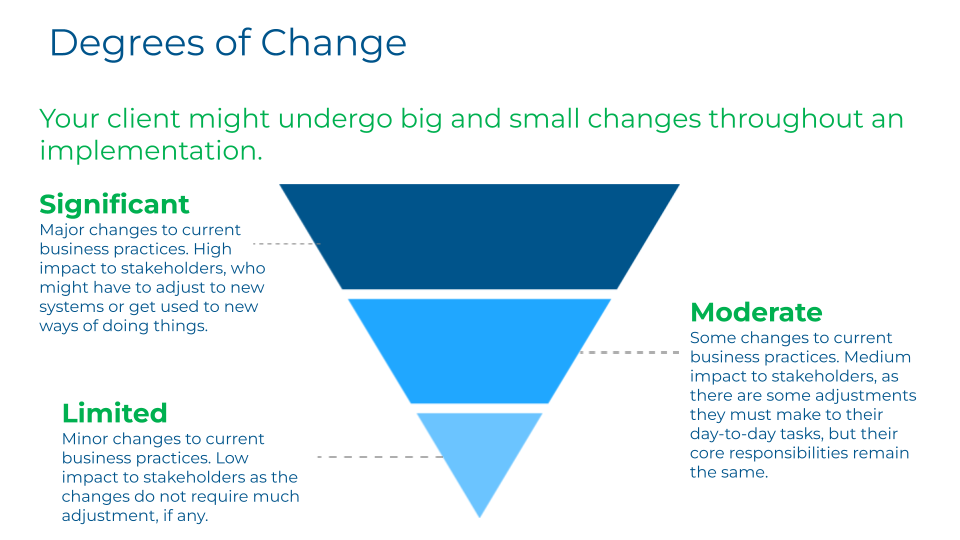
Degrees of Change
The BA's Change Management Playbook
Synthesizing everything into the loop you will run on projects:
- Diagnose the change. What is ending, for whom? (Bridges) Who wins, who fears loss? (Stakeholder analysis, Module 16)
- Build urgency and coalition. Surface the business case from discovery; recruit champions across silos. (Kotter 1-2)
- Anchor the vision in evidence. Future-state maps, benchmark data, and a believable plan. (Kotter 3, Modules 3-5)
- Communicate relentlessly, WIIFM-first. Multi-channel, repeated, modeled by leaders. (Kotter 4, Module 13)
- Remove obstacles and engineer quick wins. Old metrics, clunky approvals, missing permissions; then celebrate early value loudly. (Kotter 5-6)
- Support the neutral zone. Training, office hours, hypercare, patience. (Bridges, Modules 13-14)
- Institutionalize and improve. Documentation, onboarding, adoption metrics, continuous improvement: and keep 10-20 percent of attention on the future. (Kotter 7-8, Drucker, Module 14's sustain)
Run that loop with warmth and stamina, and you will be worth more to most projects than any amount of configuration skill.
Key Takeaways
- Change is external and fast; transition is internal and slow. Bridges' three stages (Endings, Neutral Zone, New Beginnings) explain resistance as grief and tell you where support belongs.
- Kotter's Eight Steps run from urgency and coalition through vision, communication, empowerment, and short-term wins, to consolidation and institutionalization. Skipped steps are where change efforts die.
- Drucker's frame: creative destruction spares no one; survive by leading change, managing in two time periods (10-20 percent on the future: remember Kodak versus AWS), and continuously re-answering the Five Most Important Questions: purpose, customer, value, results, plan.
- Change-leading organizations share six practices: compelling vision, systematic innovation, customer and market focus, dynamic resource management, abandonment ("would we enter this now?"), and a culture of change.
- The working toolkit: the nine-step systems change process, a cross-functional governance team, executive sponsors plus middle managers, and TAM's two levers (perceived ease, perceived value) communicated WIIFM-first.
- Your platform position makes you the organization's internal business consultant for change: spot opportunities, bring evidence, stay relentlessly positive, helpful, and determined.
Knowledge Check
8 questions. Answer at your own pace, then check the explanation for each.
Module 15 complete
Nice work. Review any question again using the menu (top right), or move on.
Continue to Module 16: Stakeholder Management & Team Collaboration →